The time when warehouses were just a box is over
Source: Trends Top 5000
Social evolutions such as multimodality and ecology, but also the need for efficient logistics and aesthetics, have radically changed the way warehouses are built. Raf Michiels, Commercial Director at Van Wellen Group, explains how these trends influence and help optimise the total cost of a warehouse.
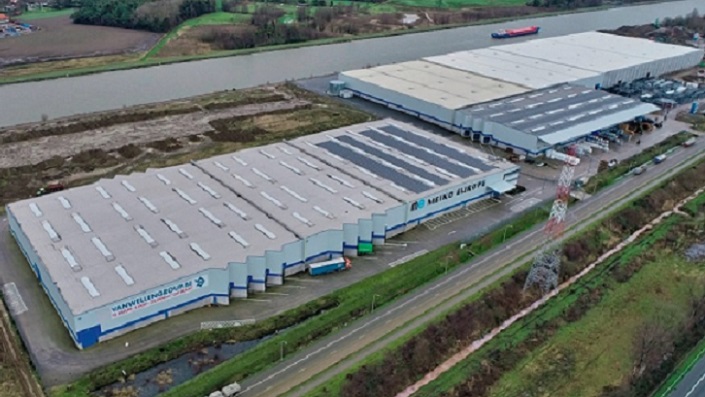
In 2020, the number of containers entering a port by ship could reach 24.000. To also avoid increasing congestion, the importance of subsequent transport via waterways has increased. "You have to take this trend into account when building a warehouse," says Raf Michiels. "Speed is important when choosing a good location for a warehouse, just look at the success of port locations. With a targeted choice, you manage to smooth out the peaks in transport flows and that ultimately results in a lower overall cost." When Michiels talks about multimodality, he thinks first and foremost of transport by water. "We have several sites with a rail connection," he says, "but at the moment the train is not a cost-effective alternative for bringing containers to an individual warehouse. More flexibility is needed for this."
ENERGY MEETS ELECTRONICS
Like multimodality, Raf Michiels also points to green energy as an investment that benefits both the sustainability and the total cost of a warehouse. Last year, Van Wellen Group put more than 50.000 square meters of solar panels into operation at its sites in the Waaslandhaven, good for a yield of 3.000 kilowatts peak. "We achieve a car consumption of around 50%. The solar panels not only provide green energy, they also enable us to reduce our users' operating costs in the long term." The large roof areas of warehouses lend themselves perfectly to the solar panels, but Raf Michiels sees other opportunities in terms of sustainability. "You can build thicker insulation, up to 10 cm for walls and 12 cm for roofs.
This ensures that you heat warehouses more efficiently in the winter and keep them cool more easily in the summer." In warehouses, LED lighting can make a difference, especially when combined with sensors and smart electricity meters. "Electronics will play an important role. That's not just about sensors for lighting, but also, for example, controlling power peaks in function of charging electric forklifts."
FROM WATER RUN-OFF TO WATER INFILTRATION
The energy-efficient interventions are currently one step ahead of the regulator, because for example, there is no EPB obligation for non-heated warehouses (and most warehouses in the port are not heated). A sustainability element that is already becoming more important for the granting of building permits is water infiltration. "We saw a huge evolution in ten years," says Raf Michiels. "From conditions to allow for delayed rainwater runoff, it went to the creation of underground buffer and infiltration basins that allow water to infiltrate into the ground. The importance of this will only increase."
IS THE SKY THE LIMIT?
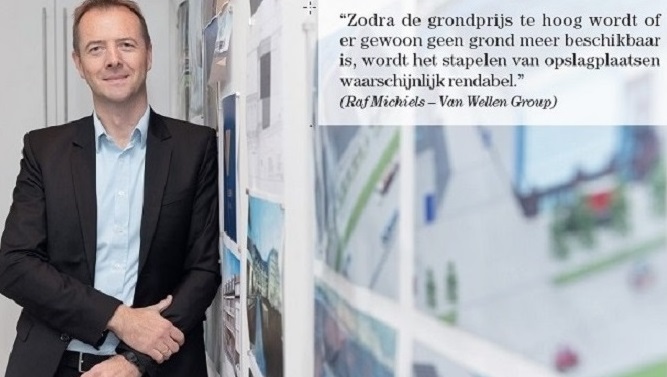
Sustainable interventions are an important link in the construction of cost-efficient warehouses, but Van Wellen Group is also seeing the height of buildings change. Warehouses are already going up to almost fifteen meters in height, as the reach of the vehicles placing the pallets increases. But multi-story warehouses, so-called multi-story buildings, are also an option. "Then we are talking about stacking warehouses, a warehouse on top of a warehouse, or creating a distribution platform for light vans on top of a warehouse," explains Raf Michiels. "Its breakthrough will be linked to land prices. As soon as the land price becomes too high or there is simply no more land available, stacking warehouses will probably become profitable."
THE EYE WANTS SOMETHING TOO
These taller buildings often come with an increased number of loading docks for trucks and vans to rotate the increased goods transported by e-commerce. If these warehouses are also increasingly located in highly visible locations, it goes without saying that the environment also experiences an aesthetic impact. "True," says Raf Michiels. "In Antwerp, for example, the architecture committee assesses the architecture of a warehouse outside the port.